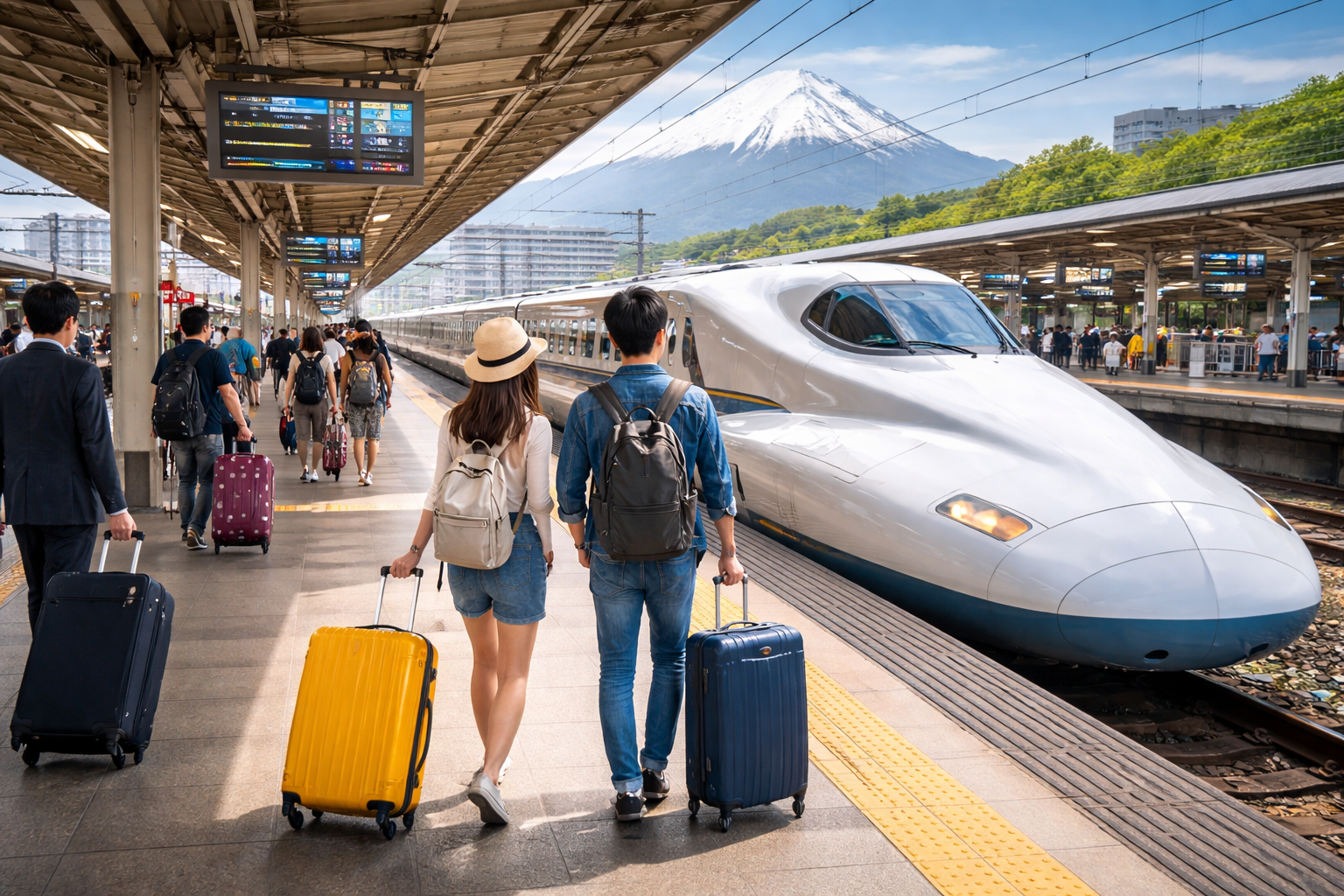
The Shinkansen (Bullet Train) is the backbone of Japanese travel, but in 2026, “just hopping on” with a massive suitcase is a thing of the past. To ensure safety and comfort for all passengers, JR (Japan Railways) enforces a strict reservation system for oversized baggage on its most popular lines.
If you are carrying a suitcase that would typically be a “checked bag” on an international flight, you must follow the “160cm Rule.” Failing to do so can result in fines and the stress of being told your luggage cannot be stored near your seat.
Here is everything you need to know about navigating the Shinkansen with your gear in 2026.
1. The “160cm Rule”: Does Your Bag Need a Reservation?
In 2026, baggage on the Shinkansen is categorized by its total dimensions (Length + Width + Height).
| Total Size (A+B+C) | Category | Reservation Required? | Storage Location |
| Up to 160 cm | Standard | NO | Overhead rack or by your feet. |
| 161 cm – 250 cm | Oversized | YES | Designated “Oversized Baggage Area” or “Compartment.” |
| Over 250 cm | Prohibited | N/A | Cannot be brought on board. Use a delivery service (Takkyubin). |
2026 Strategic Tip: Most standard 24-inch suitcases are under 160cm. Large 28-inch or 30-inch “international” suitcases almost always fall into the 161cm–250cm category and require an advance reservation.
2. The 2026 Reservation System: How to Book
There is no extra fee to reserve space for your oversized baggage if you book it at the same time as your seat. It is simply a matter of selecting the correct type of seat.
- Where to Book:
- Online: Use the SmartEX app, JR-West Online, or JR-Kyushu Online. Select “Seat with an Oversized Baggage Area” during the seat selection process.
- Ticket Machines: At the station, look for the “Reserved Seat” machines. Select the “Oversized Baggage” option.
- Ticket Office (Midori-no-Madoguchi): Simply tell the staff, “I have oversized luggage.”
- The Fine: If you bring oversized baggage onto the train without a reservation in 2026, you will be charged a ¥1,000 fee, and your bag will be moved to a location designated by the conductor (often at the far end of the car).
3. Storage Options: Area vs. Compartment
In 2026, you have two choices for where your bag lives during the journey:
A. Oversized Baggage Area (Behind the Last Row)
These are the seats in the very last row of the car. The space directly behind your seat is reserved for your luggage.
- Pro: You can see your bag easily.
- Con: You cannot recline your seat fully if your bag is extremely thick.
B. Oversized Baggage Compartment (On the Deck)
These are lockers or racks located in the deck area between cars.
- Pro: Leaves your seat area completely clear.
- Con: You need a contactless IC card (like Suica or Pasmo) to lock and unlock the compartment. Note that some mobile IC cards may not be compatible with all locker types in 2026.
4. Exceptions: Strollers, Bikes, and Instruments
The 2026 rules have specific “Common Sense” exceptions for certain items, even if they exceed 160cm:
- Strollers & Wheelchairs: You are generally encouraged to reserve an oversized baggage seat for convenience, but the ¥1,000 fine is usually waived for these essential items.
- Bicycles: Must be fully enclosed in a “Rinko” (bike bag). If they are over 160cm, a reservation is highly recommended but not strictly mandatory for the fee—however, finding space without a reservation is very difficult.
- Musical Instruments: Cello cases or guitars in hard cases are treated similarly to strollers.
5. 2026 Practical Survival Tips
- The “Sanyo/Kyushu/Tokaido” Lockdown: This reservation system is strictly enforced on the Tokaido, Sanyo, Kyushu, and Nishi-Kyushu Shinkansen lines (the routes connecting Tokyo, Nagoya, Osaka, Hiroshima, and Fukuoka).
- The “Tohoku” Difference: As of early 2026, the Shinkansen lines heading North (Tohoku, Joetsu, Hokuriku) do not yet require reservations for oversized bags, though they have introduced more luggage racks at the end of cars.
- Forwarding is Better: If you have multiple large bags, use a Luggage Forwarding Service (Takkyubin) like Yamato Transport. For about ¥2,500, they will deliver your bag from your Tokyo hotel to your Kyoto hotel the next day, allowing you to travel hands-free on the train.
- The “Non-Reserved” Trap: Oversized baggage is strictly prohibited in Non-Reserved cars. If you have a large bag, you must buy a Reserved Seat ticket.
Conclusion
Navigating the Shinkansen in 2026 is all about the “160cm” threshold. If your bag is big, book a seat in the back row. If it’s small, toss it on the rack above you. By understanding these rules, you avoid fines and ensure that your 300km/h journey across Japan is as smooth as the train itself.
Would you like me to find the closest Yamato Transport “Hands-Free Travel” counter at Tokyo Station for your 2026 arrival, or should I proceed to our next topic?
Ride the Rails with Japaner
Planning a cross-country Shinkansen journey in 2026? Japaner is your insightful thought partner for mastering Japanese transit. From helping you secure that perfect “back row” seat for your suitcase to explaining how to use your Suica card as a locker key, Japaner provides the empathetic, expert guidance you need to travel Japan’s rails with total ease.
Make your Japan trip exciting with 『Japaner Guide』
Japaner Guide is a personal guide matching service that connects you with local guides to explore destinations across Japan.

Even if you’re traveling alone and feeling unsure, you can enjoy Japan with confidence and peace of mind👍

From famous tourist attractions to hidden local gems, we customize your journey to perfectly match your interests!

👇 Sign up here 👇
https://japaner-guide.com/
Make your trip to Japan more fun and meaningful!