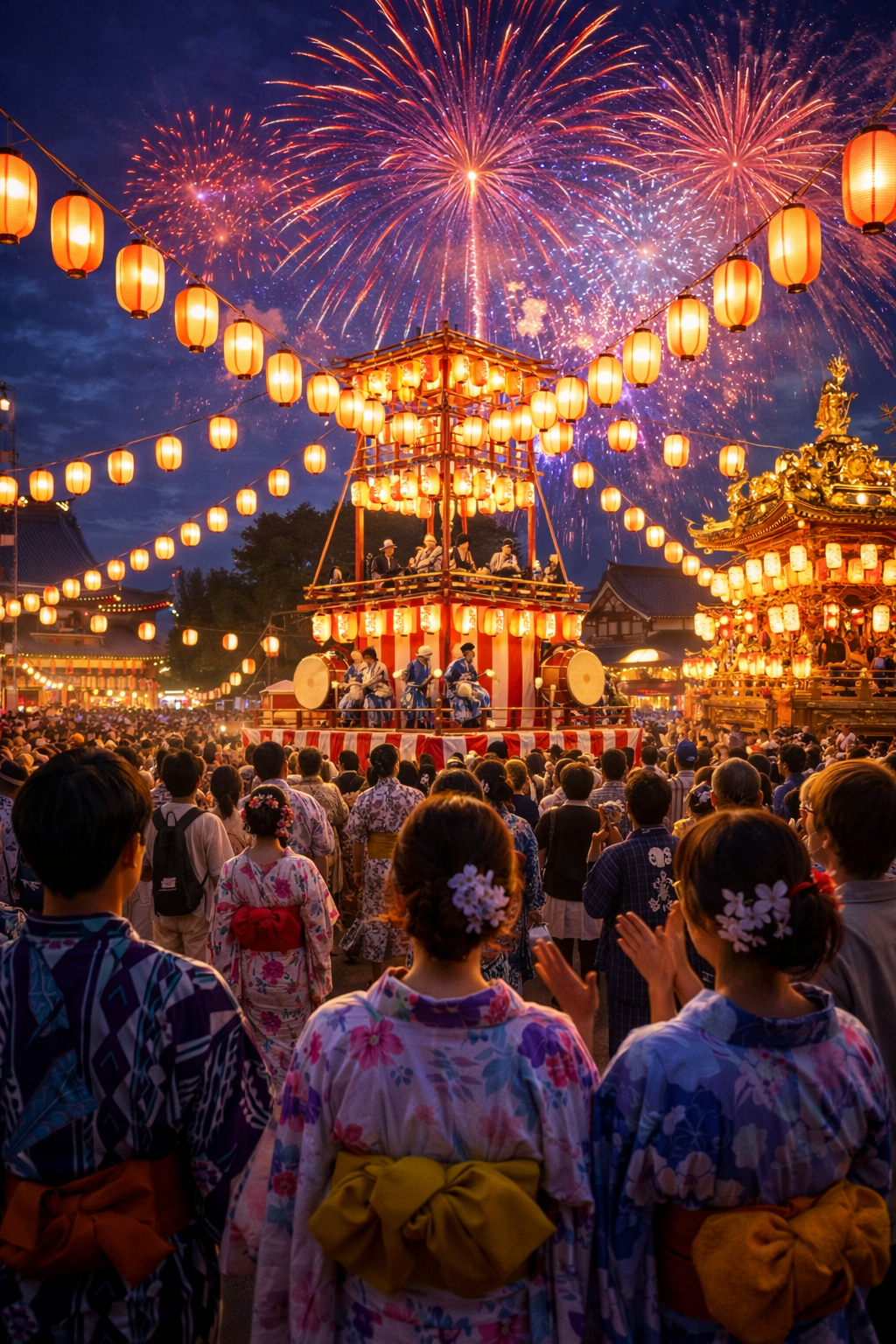
The Ultimate Guide to the Heat, Spirit, and Soul of the Japanese Summer
In Japan, summer is not merely a season; it is a spiritual awakening. As the humidity rises and the cicadas begin their rhythmic drone, the air transforms. It becomes thick with the scent of incense, grilled street food, and the distant, haunting melody of the fue (flute) and the thunderous pulse of the taiko drum. These are the sounds of the Matsuri—the Japanese festival.
For centuries, these festivals have served as the heartbeat of the nation. They are the moments when the rigid structures of Japanese society soften, allowing for an explosion of communal joy, artistic expression, and ancient ritual. Whether you are seeking the elegant, slow-moving processions of Kyoto or the frantic, sweat-soaked energy of a dance in the streets of Tokushima, understanding the festival calendar is the key to unlocking the true essence of Japan.
This comprehensive guide explores the structure, history, and timing of Japan’s most significant summer festivals, providing you with the insights needed to navigate this vibrant seasonal landscape.
Part I: The Philosophy of the Summer Matsuri
To witness a Japanese festival is to witness a conversation between the living and the divine. Most summer festivals in Japan share a common root: the need to appease the deities (Kami) and protect the community from the plagues and natural disasters historically associated with the stifling summer heat.
The Concept of “Hare” and “Ke”
In Japanese culture, Ke represents ordinary daily life, while Hare represents the extraordinary, the sacred, and the ceremonial. A Matsuri is the ultimate Hare event. It is a time to break the monotony of daily routine, to wear colorful Yukata (light cotton kimonos), and to invite the gods to dwell among the people.
The Role of the Mikoshi and Dashi
At the center of most festivals is the Mikoshi—a portable shrine that acts as a vehicle for the deity. When you see men and women chanting and heaving a heavy, ornate golden structure through the streets, they are literally taking the god for a tour of the neighborhood to bestow blessings. Conversely, the Dashi (floats) are massive, towering structures—sometimes called “moving museums”—decorated with intricate carvings and tapestries, designed to attract the attention of the heavens.
Part II: The Month of July – Elegance and Water
July marks the beginning of the peak festival season. The energy starts in the ancient capital and flows toward the merchant heart of the country.
1. Gion Matsuri (Kyoto) – The Pinnacle of Tradition
- Timeline: July 1st to July 31st
- The Vibe: Majestic, historical, and deeply ritualistic.
- Deep Dive: The Gion Matsuri is perhaps Japan’s most famous festival. Originating in 869 as a religious ceremony to quell a plague, it has evolved into a month-long celebration of Kyoto’s cultural resilience. The highlight is the Yamaboko Junko (float procession), where massive wooden floats, some weighing over 12 tons and standing several stories high, are pulled through the streets using only human strength and thick hemp ropes.
- Insider Tip: While the main processions occur on July 17th and 24th, the three nights leading up to each (Yoiyama) are when the city truly comes alive. Streets are closed to traffic, lanterns are lit, and the sound of “Kon-chiki-chin” music fills the air.
2. Tenjin Matsuri (Osaka) – The Festival of Fire and Water
- Timeline: July 24th and 25th
- The Vibe: Energetic, boisterous, and spectacular.
- Deep Dive: Osaka is known as the “City of Water,” and the Tenjin Matsuri is its ultimate tribute to the river. Dedicated to Sugawara no Michizane (the deity of scholarship), the festival features a land procession of 3,000 people in 8th-century imperial court attire. However, the true spectacle is the Funawatogo (boat procession). Over 100 boats carrying shrines and performers navigate the Okawa River under a canopy of thousands of fireworks.
- Insider Tip: Secure a spot near the bridges to see the “Dondoko-bune” (rowing boats) maneuver with incredible speed and agility, accompanied by rhythmic drumming.
Part III: The Month of August – Pure Kinetic Energy
If July is about elegance, August is about the raw, unbridled passion of the people. This is the month of the “Great Tohoku Festivals” and the legendary street dances.
1. Aomori Nebuta Matsuri (Aomori)
- Timeline: August 2nd to August 7th
- The Experience: Imagine giant, three-dimensional paper lanterns depicting fierce warriors and mythical demons, glowing from within and towering over the crowds. These are the Nebuta.
- The Dance: Surrounding the floats are the Haneto dancers. Wearing traditional straw hats and bells, they hop rhythmically on one foot, shouting “Rassera, Rassera!”
- Insider Tip: Unlike many festivals that are “viewing only,” anyone wearing the traditional Haneto costume can join the dance. It is one of the most inclusive and exhilarating ways to experience Japanese culture firsthand.
2. Awa Odori (Tokushima)
- Timeline: August 12th to August 15th
- The Experience: This is the largest dance festival in Japan. For four days, the streets of Tokushima on Shikoku Island are filled with thousands of dancers organized into groups called Ren.
- The Spirit: The famous chant says, “The dancers are fools, the watchers are fools, both are fools, so why not dance?” The Otoko-odori (men’s dance) is wild and low to the ground, while the Onna-odori (women’s dance) is graceful, performed on high wooden sandals (geta).
- Insider Tip: While there are ticketed stages, the best atmosphere is found in the “Ni-waka-ren” groups, where tourists can learn the basic steps on the spot and join the flow.
3. Akita Kanto Matsuri (Akita)
- Timeline: August 3rd to August 6th
- The Experience: Performers balance 12-meter-long bamboo poles (Kanto) weighted with up to 46 lit lanterns on their foreheads, shoulders, and hips.
- The Meaning: The poles represent ears of rice, and the lanterns represent grains of rice. It is a breathtaking display of balance and strength intended to pray for a bountiful harvest.
Part IV: Essential Practices for the Festival-Goer
To truly enjoy a Japanese summer festival, one must move beyond the role of a spectator.
1. The Attire: Yukata and Jinbei
Participating in a festival in your everyday clothes is acceptable, but wearing a Yukata (for women) or a Jinbei (for men) changes your entire experience. It is the uniform of the Matsuri. It forces you to walk smaller, stand taller, and feel the breeze in a way that modern clothing cannot mimic.
2. The Cuisine: Yatai Culture
A festival is nothing without its food stalls, or Yatai. Follow the smoke and the shouting to find:
- Yakisoba: Stir-fried noodles with a savory sauce.
- Takoyaki: Octopus-filled dough balls from Osaka.
- Ikayaki: Whole grilled squid on a stick.
- Kakigori: Shaved ice drenched in sweet syrup—the ultimate heat-killer.
3. The Etiquette
- Trash: Japanese festivals are surprisingly clean, but trash cans are rare. Carry a small plastic bag to take your trash back to your hotel or a designated disposal point.
- Space: Crowds can be intense. Maintain a spirit of Omoiyari (consideration for others).
- Small Change: Street stalls prefer cash, specifically 100-yen and 500-yen coins.
Part V: A Regional Overview of the Festival Season
| Region | Peak Period | Signature Festivals | Primary Aesthetic |
| Kyoto/Kansai | July | Gion Matsuri, Tenjin Matsuri | Historical, Traditional |
| Tohoku | Early August | Nebuta, Kanto, Tanabata | Large-scale, Visual |
| Shikoku | Mid-August | Awa Odori, Yosakoi | Dance-focused, Rhythmic |
| Kyushu | July | Hakata Gion Yamasaka | Fast-paced, Masculine |
| Tokyo | Late July | Sumida Fireworks, Bon Odori | Urban, Celebratory |
Summary: Why the Matsuri Matters
The Japanese summer festival is more than a tourist attraction; it is a profound display of a community’s soul. It represents the paradox of Japan: a culture that is deeply disciplined and reserved, yet capable of the most explosive, colorful, and uninhibited joy. To attend a Matsuri is to see the “hidden” Japan—the Japan that sweats, shouts, dances, and prays with every fiber of its being.
As the sun sets and the lanterns flicker to life, the boundary between the past and the present disappears. For one night, you are part of a lineage that stretches back over a thousand years.
Experience the Heart of Japan with Japaner
Navigating the complex schedules, local customs, and hidden gems of Japan’s festival season can be overwhelming. This is where Japaner becomes your essential travel partner.
Japaner is an AI-powered thought partner designed to provide empathetic, insightful, and deeply localized travel guidance. Whether you need a minute-by-minute itinerary for the Gion Matsuri, a list of the best Yukata rental shops in Aomori, or a secret spot to view fireworks away from the crowds, Japaner offers the intellectual honesty and warmth of a local friend.
Don’t just watch the festival—be part of it. Let Japaner curate your perfect Japanese summer adventure, ensuring you arrive at the right place, at the right time, with the right understanding.
Would you like Japaner to build your personalized festival itinerary for your upcoming trip?
Would you like me to proceed to the next article, “2. Gion Matsuri Complete Guide Month Long Festival”?
Make your Japan trip exciting with 『Japaner Guide』
Japaner Guide is a personal guide matching service that connects you with local guides to explore destinations across Japan.

Even if you’re traveling alone and feeling unsure, you can enjoy Japan with confidence and peace of mind👍

From famous tourist attractions to hidden local gems, we customize your journey to perfectly match your interests!

👇 Sign up here 👇
https://japaner-guide.com/
Make your trip to Japan more fun and meaningful!